
Guests arrive at a short-term rental knowing the WiFi password and almost nothing else.
They don’t know which hallway goes pitch black during an outage. They don’t know where the fire extinguisher is stored, or whether the drip under the water heater started an hour ago or a month ago.
That unfamiliarity is the whole problem safety gear is solving in a vacation rental, and it’s why the calculation is different from a primary residence. You are not equipping a house for people who know it. You’re equipping it for people who have never been inside.
Useful safety products in an STR tend to do one of two jobs. Some protect the guest in a moment when nobody is available to help. Others protect the owner by flagging a problem while the house sits empty.
Platform guidance sets a floor here, not a ceiling. Airbnb encourages hosts to install working smoke and carbon monoxide alarms and asks them to report those devices on the listing, where guests can filter for them, but the company does not mandate carbon monoxide alarms. Local law does the requiring, and it frequently requires more.
For this edition of STR Essentials, we picked seven products vacation rental owners may want to consider adding to their properties.
How we picked
We looked for products that solve a problem specific to short-term rentals: unfamiliar guests, unsupervised turnovers and long stretches with nobody in the building.
We also weighted low maintenance heavily. Every device that needs a battery is a device someone has to remember, and in an STR that someone is usually a cleaner working against a checkout clock.
Amazon ratings and review counts below were accurate at publication and move over time. Prices change constantly, so we’ve linked out rather than quoting them.
Disclosure: As an Amazon Associate I earn from qualifying purchases. REWire Media may earn a commission when you purchase through links in this article, at no additional cost to you.
| Product | Mainly protects | Best for |
|---|---|---|
| Kidde 10-year smoke and CO alarm | Guests | Baseline fire and CO detection |
| First Alert HOME1 extinguisher | Guests | Kitchens and common household fires |
| First Aid Only 260-piece kit | Guests | Minor cuts and scrapes |
| Kidde WiFi leak and freeze detector | The property | Empty houses and cold snaps |
| Energizer WeatherReady flashlights | Guests | Power outages |
| Kidde two-story escape ladder | Guests | Second-floor bedrooms |
| GE motion-sensor night lights | Both | Dark stairs and hallways |
1. Kidde 10-Year Smoke and Carbon Monoxide Alarm

Best for: Everyday fire and carbon monoxide protection
Amazon rating: 4.2 out of 5 stars
Reviews: 1,000+
ASIN: B0CX6BWRMM
The first item isn’t flashy, but it’s the one every host should be thinking about first.
Kidde’s combination alarm detects both smoke and carbon monoxide in one unit and runs on a sealed 10-year battery. There are no removable batteries.
That matters more in a rental than it does in a house. The classic failure mode in an STR isn’t a dead alarm, it’s a disabled one: a unit chirps at 2 a.m., a guest or a cleaner pops the battery out to make it stop, and the next four guests sleep under a device that does nothing.
A sealed unit takes that option off the table. It does not take maintenance off the table.
Alarms still need to be tested regularly and replaced on the manufacturer’s schedule. One unit also rarely covers a whole property. Many jurisdictions require an alarm on every level and inside or near every sleeping area, so check your local code before you decide how many to order.
One more thing worth knowing before you buy: Airbnb has run a program for years that ships eligible active hosts a free combination smoke and CO alarm. It’s one device per host, so it won’t equip a five-bedroom cabin, but it’s free and most hosts never claim it.
2. First Alert HOME1 Fire Extinguisher

Best for: Kitchens and general household fire protection
Amazon rating: 4.8 out of 5 stars
Reviews: 39,000+
ASIN: B01LTICQYE
A fire extinguisher doesn’t do much good if a guest has to dig through a utility closet to find it.
The First Alert HOME1 is rated 1-A:10-B:C and is designed for several common household fire types, including wood, paper, trash, gasoline, oil and electrical equipment. That covers most of what goes wrong in a rental kitchen.
It has an easy-to-read pressure gauge, which is the feature that makes it practical for a rental. A cleaner can confirm the needle is in the green in about two seconds during a turnover, with no training required.
Placement deserves more thought than it usually gets. Mount it where a guest can grab it without walking toward the stove, because an extinguisher stored behind a range is one a person cannot reach during the fire it was bought for.
Larger homes and some local fire codes call for more than one. Whatever you install, note its location in the house manual and treat any unit that has been discharged, even briefly, as needing service or replacement.
3. First Aid Only 260-Piece First Aid Kit

Best for: Stocking one central first-aid location
Amazon rating: 4.8 out of 5 stars
Reviews: 5,000+
ASIN: B08P27LHJ4
A vacation rental first-aid kit should probably contain more than five Band-Aids and a tube of antibiotic ointment that’s been sitting under the bathroom sink since 2019.
This First Aid Only kit includes 260 pieces in an organized case, covering common minor cuts, scrapes and everyday injuries.
The organization is the reason we like it for an STR, not the piece count. A turnover team can see at a glance that the gauze slot is empty. Nobody can audit a drawer.
Worth deciding deliberately: what you stock beyond wound care. Some operators pull oral medications out of guest kits entirely and leave only bandages, gauze and antiseptic, on the view that supplying pills to strangers invites questions they’d rather not answer. If that tradeoff matters to your risk profile, it’s a conversation for your insurer or attorney, not a product spec.
Put it somewhere obvious, name the location in your house manual and check for used or expired items on a set schedule.
4. Kidde WiFi Water Leak and Freeze Detector

Best for: Protecting an STR when nobody is there
Amazon rating: 4.0 out of 5 stars
Reviews: 700+
ASIN: B0B2KPL9CC
This is the product on the list with the most direct financial benefit to the owner.
A dripping supply line behind a washing machine can run unnoticed for days in a house between bookings. Kidde’s detector sends a smartphone notification when it senses water, which turns a gap-week flood into a phone call.
It also watches temperature and can alert when conditions reach 37 degrees or when it detects a rapid drop. That makes it particularly interesting for mountain cabins, ski rentals and any property that sits cold and empty in shoulder season.
Kidde says the compact battery-powered sensor can go near water heaters, dishwashers, refrigerators, toilets and under sinks. Those are also, not coincidentally, the five places most water damage claims start.
Be clear about what you’re buying, though. This is an alarm, not a shutoff valve. It tells you water is on the floor; it does not stop the water, and it needs a live WiFi connection to tell you anything at all.
It also carries the lowest rating on this list at 4.0 stars, and connectivity complaints are a recurring theme in that category generally. An alert is only worth what your response plan is worth, so pair it with a local contact who can actually get to the property.
5. Energizer WeatherReady Auto-On Rechargeable Flashlights

Best for: Power outages
Amazon rating: 4.7 out of 5 stars
Reviews: 7,000+
Package: 3-pack
ASIN: B08WCHXYLP
You can put a flashlight in a kitchen drawer. The problem is that your guest doesn’t know which drawer, and now it’s dark.
Energizer’s WeatherReady lights solve that in a way that suits rentals well. They plug into standard wall outlets to stay charged and illuminate automatically when the power cuts out, so the flashlight announces itself instead of waiting to be found.
A guest can then pull one out of the outlet and carry it.
The three-pack makes it easy to cover a larger property. Consider one in the main living area, one at the top of the stairs and one in a bedroom hallway.
Two practical notes. They occupy an outlet, and guests unplug things to charge phones, so plugging them back in belongs on the turnover checklist. And an outlet behind a sofa is a wasted unit, since a light nobody can see is a light nobody uses.
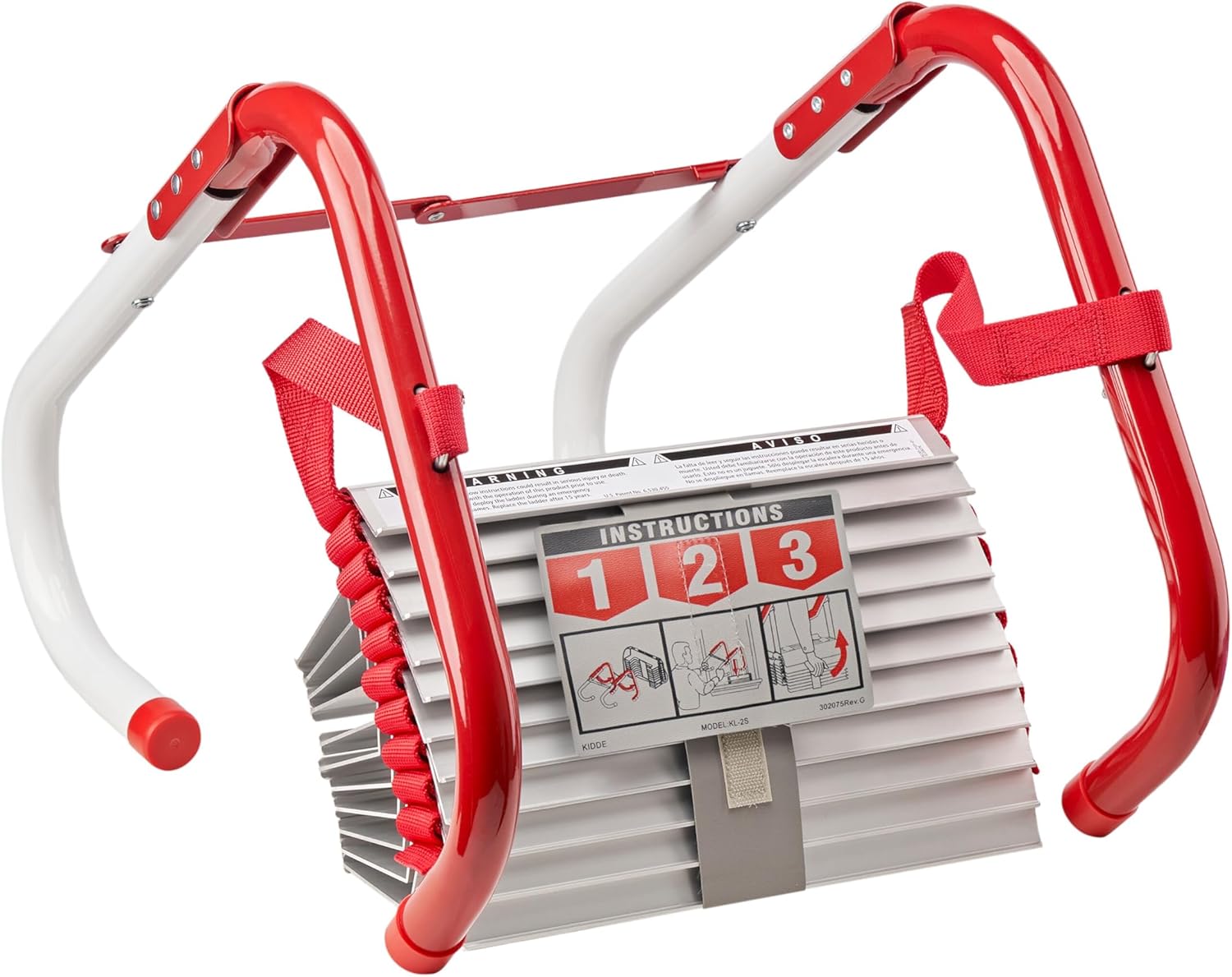
6. Kidde Two-Story Fire Escape Ladder
Best for: Second-floor bedrooms
Amazon rating: 4.7 out of 5 stars
Reviews: 20,000+
Length: 13 feet
ASIN: B00005OU7B
If guests sleep upstairs, it’s worth thinking through how they’d get out if the route downstairs became unusable.
Kidde’s two-story ladder extends to 13 feet, folds for storage and hooks over compatible windows with no permanent installation. For a rental, that last part is the selling point, since nothing about it modifies the property.
This one is not a universal purchase, and we’d push back on anyone who treats it as one. Window size, sill construction, floor height, landscaping below the window and local requirements all matter. Confirm an escape ladder is appropriate for your specific property before buying.
Storage location is the part hosts get wrong. A ladder in a basement bin protects nobody.
Keep it in the room it serves, put its location in the written emergency instructions and make sure a guest could work out how to deploy it while frightened and half awake. That is the actual test.
7. GE Motion-Sensor LED Night Lights

Best for: Dark hallways, stairs and bathrooms
Amazon rating: 4.7 out of 5 stars
Reviews: 3,000+
Package: 2-pack
ASIN: B07QQ8B141
This is the cheapest item on the list and arguably the one that prevents the most likely incident.
A guest wakes at 2 a.m. in an unfamiliar bedroom, tries to find the bathroom without waking the house and meets a staircase they’ve walked exactly once, in daylight.
GE’s plug-in lights detect motion from up to 25 feet, put out 40 lumens and switch off after 90 seconds without movement. No guest has to find a switch on an unfamiliar wall.
The unglamorous reason to buy them is claims. Slips and falls on stairs are among the more common guest injuries in a rental, and a night light is a very cheap way to make a dark landing visible.
Just don’t confuse them with an outage plan. At 40 lumens these are guide lights, not room lighting, and a plug-in unit does nothing when the power is off. That’s what the flashlights are for.
One safety essential you don’t have to buy
You could buy everything on this list and still leave guests unprepared, because none of it is labeled and none of it is where they’d think to look.
Put a simple emergency information sheet somewhere visible inside the rental. Not in a binder in a drawer. On a wall, or on the fridge.
Lead with the property’s full street address. Guests calling 911 from a house they arrived at after dark routinely cannot say where they are, and dispatchers cannot send anyone to “the cabin with the red door.”
Then add the rest:
- Emergency contact for the host or property manager
- Location of fire extinguishers and the first-aid kit
- Location of any escape ladder, and which window it fits
- Primary and secondary exit routes
- Water shutoff, gas shutoff and breaker panel locations
- Nearest urgent care and emergency room
Then make safety checks part of the normal turnover routine, because equipment degrades quietly.
Alarms need to be tested. Extinguisher gauges need to sit in the green. First-aid supplies need restocking. Flashlights need to be plugged back in. A leak sensor is worthless if its alerts land in a notification tab nobody opens.
Hosts who rely on cleaners or property managers should put those recurring checks in writing rather than assuming them. REWire recently looked at what hosts should include in a short-term rental cleaning agreement, and a safety-check line item belongs in that document.
Finally, don’t mistake an Amazon order for compliance. Fire, carbon monoxide and short-term rental safety rules vary by jurisdiction, and in many markets they’re written into the permit itself.
Local requirements determine what you install and where. This list is a starting point for that conversation, not a substitute for it.


