
Smart thermostats that actually work for short-term rental operators
Guests check out Friday morning. The next party arrives Friday afternoon. For six hours in between, your HVAC runs at full blast. That unmanaged temperature use is one of the most consistent margin leaks in short-term rental operations, and it’s often preventable.
Most consumer thermostats are built for households with predictable routines.
STR-grade thermostats need to survive constantly changing guest patterns, remote management demands, and the occasional visitor who cranks the heat to 85 and leaves. The best thermostat for this use case is not the one with the nicest display — it’s the one that lets you set rules, enforce limits, and respond to reservation events without manual intervention.
Editor note: Picks were evaluated on PMS integration depth, remote management reliability, and multi-property scalability.
Disclosure: As an Amazon Associate, REWire Media may earn from qualifying purchases. This article contains affiliate links, and we may earn a commission at no additional cost to you.
How we picked: We prioritized products with remote app control, guest-friendly local controls, documented smart-home or middleware integration paths, and pricing that makes sense across multiple properties. Exact compatibility varies by HVAC system, PMS, region, and subscription plan, so hosts should verify model-level support before standardizing.
| Product | Best For | Connectivity | PMS / Automation Path | Host Controls | Remote Sensors |
|---|---|---|---|---|---|
| Ecobee SmartThermostat Premium | Best Overall | WiFi Built-In | Operto; verify middleware support | Schedules / holds / occupancy rules | Yes |
| Amazon Smart Thermostat | Best Budget | WiFi Built-In | None native | Basic app scheduling | No |
| Google Nest Learning Thermostat (4th Gen) | Best Premium Pick | WiFi Built-In | Google Home / Matter; verify Operto | PIN / range lock | Yes |
| Ecobee SmartThermostat Enhanced | Best for Multi-Property Hosts | WiFi Built-In | Operto; verify middleware support | Schedules / holds / occupancy rules | Yes |
| Honeywell Home T9 Smart Thermostat | Best for PMS Integration | WiFi Built-In | Seam-supported path; verify PMS + model | Schedules / temp lock | Yes |
| Emerson Sensi Touch 2 Smart Thermostat | Best for Remote Hosts | WiFi Built-In | Sensi app + smart-home; verify middleware | Schedules / app controls | Yes |
Ecobee SmartThermostat Premium
$199–$249 | 4.3/5 (3,000+ Amazon reviews)

The Ecobee Premium brings together occupancy sensing, broad smart home platform support, and a mature remote management interface — three things that matter daily in a rental operation. At the price, it’s the most complete single-unit solution on this list for hosts who manage properties with existing automation stacks.
STR Use Case: STR hosts use Ecobee for remote temperature control, occupancy-based scheduling, and integration with smart home platforms to reduce HVAC costs between stays.
PMS / Automation Path: Operto; RemoteLock or other middleware may support thermostat workflows depending on device and plan. Verify before standardizing.
- Built-in occupancy sensing can support automations and comfort/efficiency features, though STR hosts should still configure holds, schedules, and integration rules carefully
- Built-in Alexa voice support plus Apple Home, Google Home, SmartThings, and Alexa ecosystem compatibility gives hosts flexible automation options
- Web and app-based remote control functions reliably for off-site management
- Native direct integration with major PMS platforms like Guesty or Hospitable requires a middleware platform such as Operto or Seam, adding cost and complexity — budget for that layer before purchasing.
This is right for you if: You already use or plan to adopt Operto or compatible middleware and want a thermostat that slots into an existing automation workflow with built-in occupancy sensing.
Amazon Smart Thermostat
$59–$79 | 4.0/5 (25,000+ Amazon reviews)
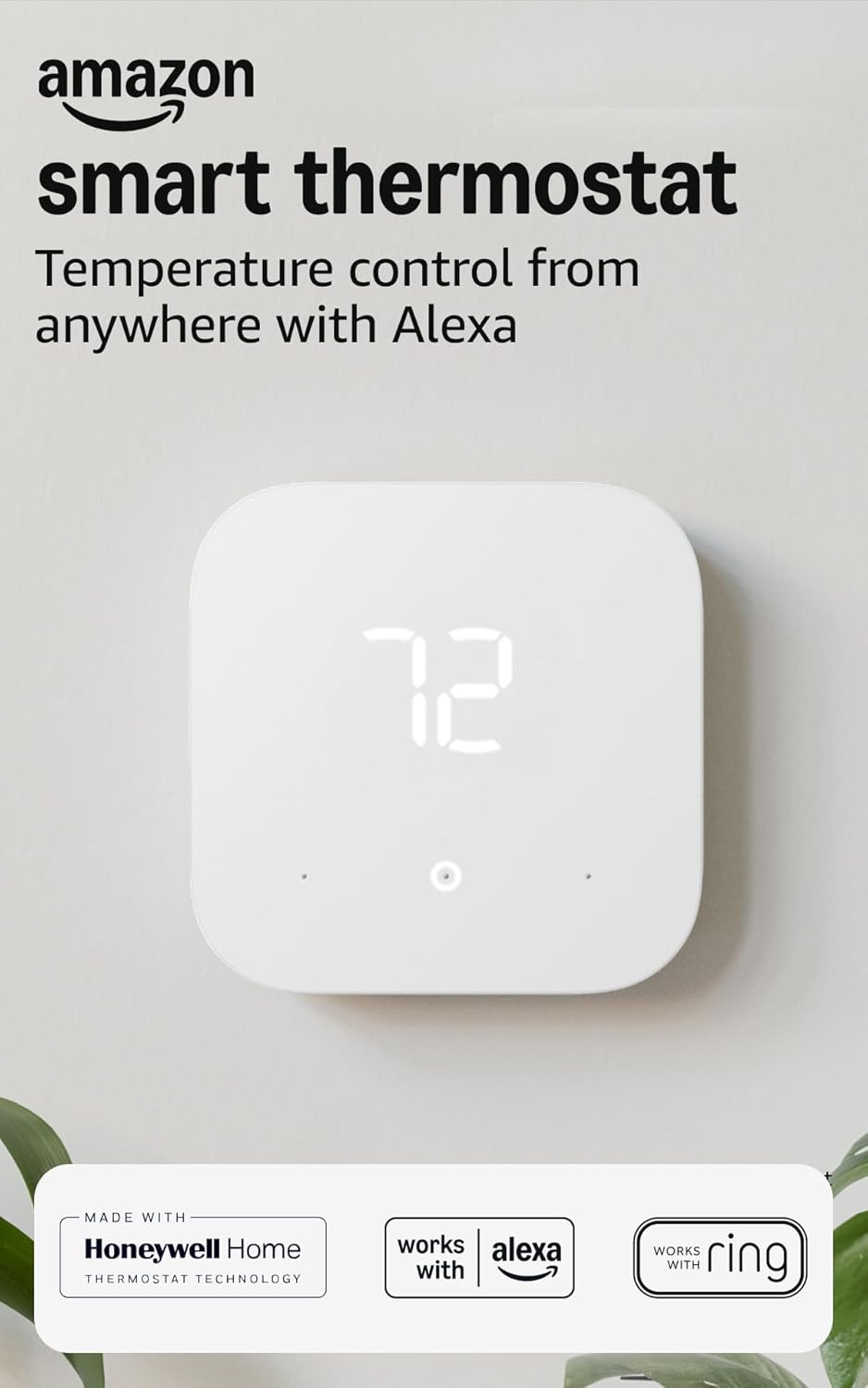
At under $80, this is the lowest barrier to remote temperature control available from a credible hardware maker. Designed and developed by Amazon and Resideo, it handles the basics — remote access via the Alexa app, ENERGY STAR efficiency — without unnecessary complexity.
STR Use Case: Budget-conscious STR hosts use this thermostat for basic remote temperature control via the Alexa app, keeping costs low across multiple low-margin properties.
- ENERGY STAR certified — measurable efficiency gains even without advanced scheduling
- Works with Amazon Alexa for voice control and remote adjustments through the Alexa app when the thermostat and host device have internet access
- Straightforward install and setup keeps per-unit deployment time low across a portfolio
- Requires a C-wire or compatible power setup, which can complicate installation in older homes — check your wiring before ordering.
- No native PMS integrations and limited scheduling automation compared to premium options — reservation-triggered temperature changes will require manual scheduling or separate automation workarounds.
This is right for you if: You operate low-margin properties where the ROI on a $200 thermostat doesn’t pencil out and basic Alexa-based remote control covers your actual workflow.
Google Nest Learning Thermostat (4th Gen)
$229–$279 | 4.4/5 (2,000+ Amazon reviews)

The 4th Gen Nest is the most guest-facing device on this list — polished hardware, a refined interface, and a design that reads as premium to guests who notice these things.
Remote management via Google Home is reliable, and PIN-based range locks give hosts a practical way to cap guest overrides.
STR Use Case: STR hosts seeking a premium guest experience use the Nest Learning Thermostat for its polished design, self-learning capability, and remote management via the Google Home app.
PMS / Automation Path: Google Home / Matter-compatible workflows; confirm current Operto or middleware support for this exact model before purchasing.
- PIN-based temperature range locks can help prevent extreme guest overrides — a directly STR-relevant control
- Self-learning scheduling adapts to usage patterns — useful for owner-occupied properties, requires monitoring in pure-rental contexts
- Google Home and Google Assistant integration fits portfolios already running Google ecosystem devices
- Designed for many 24V systems, with Google Home setup and compatibility checks; some systems may require a C-wire, Nest Power Connector, or professional installation
- Self-learning behavior can conflict with STR operations where guest patterns are unpredictable — hosts should disable auto-schedule and take manual control to prevent the thermostat from “learning” guest preferences into the base schedule.
This is right for you if: You operate a design-forward property where hardware aesthetics matter to your guest demographic and you want PIN-based override control in the Google ecosystem.
Ecobee SmartThermostat Enhanced
$149–$179 | 4.4/5 (3,500+ Amazon reviews)

The Enhanced is the per-unit economics version of the Premium — lower cost, same Ecobee platform, same integration support. For operators standardizing hardware across five or fifteen properties, that consistency in the management dashboard is worth more than any single feature.
STR Use Case: Multi-property STR operators use the Ecobee Enhanced for its lower per-unit price, web dashboard for managing multiple devices, and compatibility with property automation platforms.
PMS / Automation Path: Operto; RemoteLock or other middleware may support thermostat workflows depending on device and plan. Verify before standardizing.
- Web and mobile dashboard supports managing multiple thermostats from a single login — no per-property logins required
- Vacation and hold modes can be adapted to STR turnover workflows, though reservation-aware automation still depends on middleware
- Compatible with Alexa, Google Assistant, HomeKit, and SmartThings — works alongside whatever ecosystem is already at each property
- Ecobee’s platform does not natively ingest reservation data from PMS tools — a third-party integration layer through Operto or compatible middleware is still required for fully automated guest-based scheduling, which adds per-property cost.
This is right for you if: You’re standardizing smart thermostats across a multi-property portfolio and want a single management dashboard with Operto or compatible middleware already in your stack.
Honeywell Home T9 Smart Thermostat
$149–$199 | 4.4/5 (1,800+ Amazon reviews)

The T9’s primary advantage is its position in Seam’s device API, which provides a supported path toward STR automation platforms. For hosts whose entire operation runs through a compatible PMS, this is the clearest route to reservation-triggered temperature automation.
STR Use Case: STR hosts use the T9 because it is supported by Seam’s unified API, which can support reservation-based temperature automation when configured through a compatible PMS or middleware workflow.
PMS / Automation Path: Seam-supported automation path; confirm your exact PMS and thermostat model before standardizing.
- Supported by the Seam device API for programmatic control — can support reservation-based temperature automation when configured through a compatible PMS or middleware workflow
- On-device screen lock options can limit guest changes at the thermostat, giving hosts more control than schedule-only setups
- Remote room sensor support enables multi-room occupancy detection, not just single-point thermostat sensing
- Works with major smart-home ecosystems, but hosts should verify HomeKit and app support for the exact model before purchasing
- PMS integrations run through Seam or similar middleware — hosts must configure and maintain third-party API connections for automation to function; verify compatibility with your specific PMS before purchasing.
This is right for you if: You run your operation through a compatible PMS and want temperature automation that responds to reservation events through Seam’s supported path.
Emerson Sensi Touch 2 Smart Thermostat
$129-$149 | 4.4/5 (200+ Amazon reviews)

The Sensi Touch 2 earns its remote-host designation through a combination of a clear color touchscreen that guests can operate without calling for help, and a Sensi app that surfaces remote override without burying it in menus. Mid-range price, broad ecosystem compatibility, and a straightforward setup make it a practical default for remotely managed properties.
STR Use Case: Remote STR hosts value the Sensi Touch 2 for its reliable WiFi-based remote access, clear touchscreen for guest interaction, and straightforward mobile app that does not require complex setup.
PMS / Automation Path: Sensi app and smart-home integrations; confirm middleware support before purchasing.
- Color touchscreen display gives guests a clear, intuitive interface — reduces “how do I change the temperature” support contacts
- Flexible scheduling with remote override via Sensi app keeps the host in control between guest adjustments
- Works with Alexa, Google Assistant, Apple HomeKit, and SmartThings — fits most existing smart home configurations without conflict
- Requires a C-wire, which can complicate installation in older STR properties — check your wiring before ordering.
- Remote app control depends on the property’s internet connection; if WiFi or broadband goes down, off-site control may be unavailable until connectivity returns — for unmanaged remote properties, a router on a smart plug or cellular backup should be considered a paired requirement.
This is right for you if: You manage properties remotely without on-site staff and need a thermostat guests can operate themselves while you retain override control from anywhere.
What to look for in STR-grade smart thermostats
PMS integration depth is the first question to answer — not whether a thermostat “integrates” in a general sense, but whether your specific platform can trigger temperature changes automatically on check-in and check-out for that exact device. Confirm whether the integration is one-way or two-way, and whether middleware adds a recurring cost before you standardize across a portfolio.
Remote management reliability matters more than feature count for hosts who aren’t on-site. A thermostat that offers 12 automation modes but loses remote access when the router reboots is a liability, not an asset. Evaluate how the device behaves when WiFi is interrupted, and whether the property’s network setup is stable enough to support it.
Guest-facing usability is often underweighted in buying decisions. A confusing interface generates support contacts; a clear one does not. The best outcome is a guest who adjusts the temperature themselves, never calls, and leaves a five-star review — which means the physical display and local controls matter as much as what the host can do from the app.
How we evaluated these products
Every product was evaluated through an operator lens, not a consumer one. Criteria included: depth of PMS integration and the middleware requirements behind it, viability for multi-property management from a single dashboard, reliability of remote access for off-site hosts, and the guest-facing experience at the device itself. Price was weighted against realistic per-unit ROI at different portfolio sizes.
Products that offered remote access only through voice assistants with no standalone app were excluded — that workflow is not practical for operational temperature management. Products were not required to have PMS integration, but those without it needed to offer a clear STR use case such as low cost, strong remote control, or guest-friendly local controls.
*As an Amazon Associate, REWire Media earns from qualifying purchases. This article contains affiliate links and we may earn a commission at no additional cost to you. Amazon links use tag rewiremedia-20.*


